
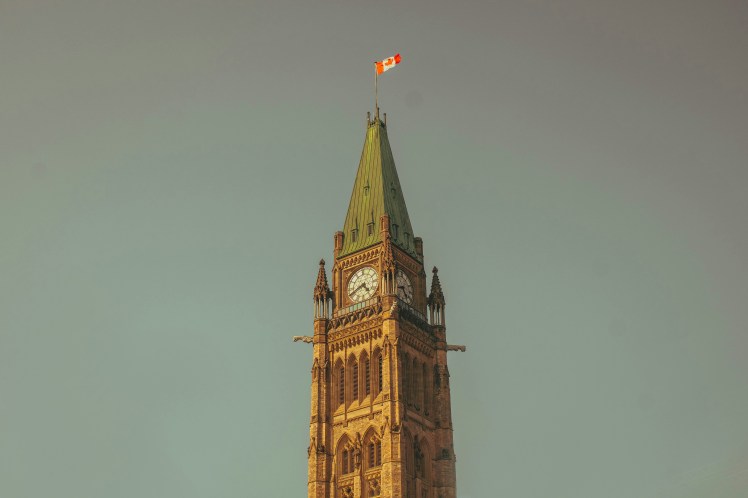
Yesterday, November 11, I attended a Remembrance Day ceremony in St. Catharines, Ontario.
As we gathered to remember the men and women who served, sacrificed, and gave their lives for our country, one particular statement from a speaker caught my attention.
He reminded us that it is not only our military who must stand for our country. We, as citizens, also have a responsibility to “stand up for what is right.”
Sounds noble in the moment. But immediately I thought…. “right” according to whom?
It sounds universally agreeable. Who wouldn’t want to stand up for what is right?
Therein lies the problem.
We can all agree that we should stand up for what is right. However, agreeing what is “right” is another thing entirely. And it needs clarification to even stand up for it.
I don’t think we Canadians are nearly as united as implied.
A Changing Canada
Canada was built with a profound influence from Christianity and biblical principles. Our laws, institutions, educational systems, and understanding of morality were shaped considerably by a Christian worldview.
Canada was never a perfect Christian nation, nor have Christians always acted according to the truths they professed.
But there was a broadly recognizable Christian moral framework influencing much of Canadian public life.
Today, our religious landscape is considerably different.
According to Statistics Canada’s 2021 Census, 53.3% of Canadians identified as Christian. Another 34.6% reported no religious affiliation (often called “Nones”). Islam, Hinduism, Sikhism, Buddhism, Judaism, and numerous other religious traditions make up much of the remainder.
And yes, even “Nones” have beliefs. They may not subscribe to an organized religion, but that doesn’t mean they approach questions of truth, morality, and human existence without convictions.
Everyone believes something.
And all these beliefs affect how we determine what is right and how that gets lived out.
We Cannot All Be Right
Consider some of the fundamental differences between the major religions and worldviews represented in Canada.
- Christianity teaches that Jesus Christ is God incarnate. Islam expressly denies it.
- Christianity teaches that we live once and then face judgment. Hinduism, Buddhism, and Sikhism teach forms of rebirth.
- Christianity teaches that humanity’s greatest problem is sin, and that salvation is found in Jesus Christ. Buddhism approaches the human predicament through suffering, craving, and ignorance.
- Many secular worldviews reject any existence of God while many faiths say there is a God.
These are not minor differences of interpretation. They are fundamentally conflicting claims about reality. They cannot all be true in the same sense.
Our beliefs about God (or no God), humanity, truth, and eternity inevitably influence what we believe to be right and wrong. They shape our thinking about marriage, family, education, justice, human dignity, freedom, and the responsibilities of government.
Perhaps for a time, people from differing religions can agree on various moral outworkings. To some extent we can agree that generosity is good, that murder is wrong, and that people ought to be treated with dignity (but even what that looks like is handled differently). But agreement on particular moral conclusions doesn’t necessarily mean agreement on the foundation of those conclusions.
And when we disagree, where do we turn to determine who is right?
Can Government Decide?
Some might suggest that government, through legislation and the democratic process, provides the answer. But this is problematic.
Government is said to be morally neutral. Well, sorry, it can’t be.
Every government operates according to certain beliefs about human nature, justice, freedom, authority, and the purpose of society. Those beliefs influence the laws it introduces, the policies it implements, and the behaviours it encourages or restricts.
A government may claim religious neutrality, but it cannot escape making moral judgments. Even to attempt to govern without God or reference to God reflects a particular, albeit limited, understanding of moral and political authority. Governing authorities are God’s servants, accountable to Him (see Romans 13:4-6). There is a real danger when government acts as though it possesses the ultimate authority to determine good and evil.
Government is not God.
And actually, neither is democracy.
Consider this troubling possibility: What if a majority of Canadians decided tomorrow that persecuting Christians was acceptable? Or eliminating Jews? History has demonstrated that entire societies can embrace horrific evils, sometimes with the full support of their governments and legal systems.
Do such actions become right simply because a majority approved? Of course not!
A thousand people agreeing that something is right does not make it right if it is inherently wrong. Neither can a million. Neither can an entire country.
A foundation for what is right is needed, despite public opinion. And to stand up for what is right centers on that foundation.
Laws can establish what is legal. Public opinion can establish what is popular. But neither, by itself, establishes what is true or morally right.
This is why the question of our moral foundation matters so deeply.
Truth Is Not Determined by Consensus
Truth is not something humanity gets to invent, redefine, or establish by majority vote.
Truth exists independently of us. And ultimately, truth is not merely a principle or philosophical concept.
Truth is a person. Jesus Christ. And all truth stems from Him.
He declared: “I am the way, and the truth, and the life.” (John 14:6)
This is an extraordinary claim.
And it is one that places Christianity and the Christian moral framework of Canada in direct conflict with numerous other infiltrating understandings of ultimate truth.
Many in Canada do not believe the words of Jesus nor in Jesus Himself.
But disagreement about truth does not mean truth ceases to exist. Nor does it mean that all competing claims are equally valid.
We must distinguish between respecting someone’s freedom to believe and accepting that what they believe is true. Those are two very different things. And again, this impacts how someone “stands up for what is right”.
I can respect my neighbour, defend his freedom of conscience, and treat him with dignity without surrendering my conviction that his beliefs may be mistaken. And he can do likewise toward me. But neither of us resolves our disagreement by pretending it doesn’t exist.
What Are We Actually Standing For?
Which brings me back to the Remembrance Day ceremony.
I deeply appreciate the speaker’s challenge. Citizens ought to stand up for what is right.
We ought to demonstrate courage and conviction, and not merely rely upon those who serve in our armed forces to defend our country and its freedoms.
But we must ask ourselves what we mean by those words.
Are we standing for what is right according to Scripture? Or according to another religious tradition? Or according to government? Or according to the latest cultural consensus? Or according to whatever seems right in our own eyes… you do you?
These questions matter because the answers have consequences.
This country and its freedom came about at a great cost. Canada and the United States have enjoyed remarkable freedoms, and I believe both nations have been richly blessed by God. Their Christian heritage profoundly influenced their understanding of freedom, law, and justice, and the responsibilities that come with each.
And many Canadians no longer acknowledge this great provision from God, or their need for Him; they’ve abandoned the beliefs of previous generations. Others who come here enter in with their own gods and beliefs. What we are left with is a slurry of conflicting convictions, empty slogans, and fading national identity.
Today’s society leans on the freedom, justice, and human dignity, which stem from the Christian way. Many are enjoying it and yet abusing it… and sadly it is vanishing before our eyes.
To “stand up for what is right” would be to first fall down and repent before God… that we are abusing this nation where He used to be honoured and praised. And then after repenting, to stand… and indeed take a stand… and stand up for what is right according to the Word of God. After all it is etched in stone in the very Parliament buildings in our nation’s capital.
The men and women we remember on November 11 deserve our gratitude. Their service and sacrifice should never be diminished.
But remembering their sacrifice also presents us with a responsibility to think seriously about the kind of country we want to see rebuilt now because many have begun tearing it down.
Standing up for what is right will take courage and wisdom, and squaring it to the foundation of Truth which is Jesus Christ.
He alone determines what is right and gives the capacity to stand firm in that.
Photo by Hamid Siddiqi on Unsplash

